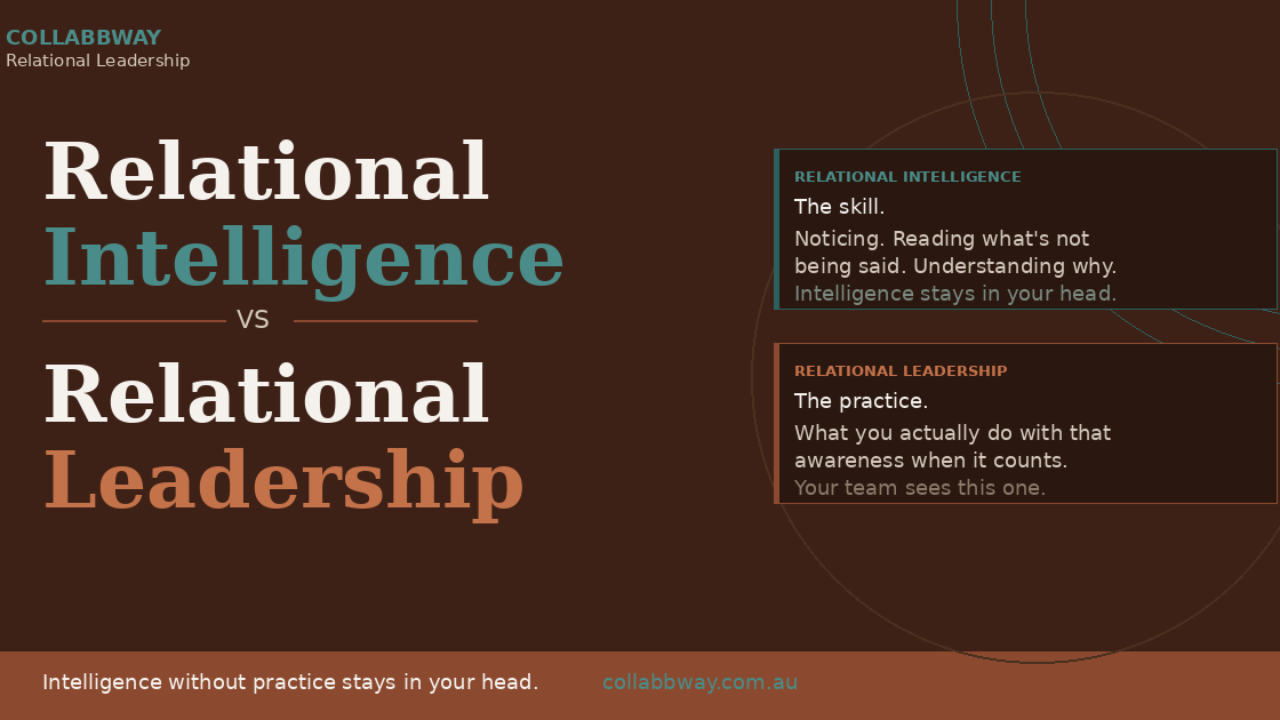
Relational intelligence is the skill. Relational leadership is the practice.
Oct 07, 2026Everyone's talking about relational intelligence right now. Esther Perel brought it to Australian audiences this year, calling it the new competitive advantage for leaders and teams. Leadership programs are picking it up fast.
Good. It's overdue. But there's a gap I keep seeing.
You can understand people really well and still freeze when someone cries in your 1:1 meeting. You can read the room perfectly and still let the same issue slide for six months. For most managers, knowing isn't the problem. Doing it, on a busy Tuesday, under pressure, with ten other things on your mind, is the problem.
So here's the difference I'd draw.
1. Relational intelligence is the skill. Noticing tone. Reading what's not being said. Understanding why people react the way they do.
2. Relational leadership is the practice. What you actually do with that awareness in the moments that count - i.e. who you check in with, what you say first and whether you raise the small thing before it becomes the BIG thing.
Intelligence without practice stays in your head. Your team never sees it.
What 40+ managers told me
Between January and May this year, I talked with more than 40 managers about what's really going on in their teams. Not what they'd say in a performance review to their manager. What it's actually like.
What came back wasn't a list of skill gaps. It was relational pressure. Accountability that isn't being taken on. Feeling more like a sounding board than a boss. Senior leaders who don't back them up. Looking after everyone else's burnout while running on empty themselves.
One manager put it simply: "I feel like I'm part counsellor, part leader. It's draining."
And it was rarely that they didn't know what good leadership looks like. They knew. The hard part was doing it under pressure, with someone upset in front of them.
Read the full Manager Insights 2026 findings
The wider research points the same way
In 2025, the Australia and New Zealand School of Government published a report by a UNSW team on relational leadership as a way to build capability in the public service. It brings together 30 years of reports and finds relational leadership consistently linked with productivity, innovation and how well teams learn.
One idea in it stays with me. It describes two kinds of leaders: those who take up space, and those who hold space.
- Taking up space is planning, directing, telling.
- Holding space is making it possible for people to speak up, try things, and tell you the truth.
Most managers were trained to take up space. Nobody showed them how to hold it.
Where it breaks down
Managers don't struggle with relationships because they don't care. It breaks down in specific moments:
- The feedback you soften until it means nothing
- The conflict you hope will sort itself out
- The 1:1 that's turned into a status update
- The change you announce without checking how it's landing
These are behaviours, not personality traits. Which means they can be learned.
Turning it into good leadership practice
This is why I built the Relational Leadership Method (RLM). It comes from over 20 years working in social work, community services, and edication, in family violence, mental health, and child and family services. In that work, if the relationship breaks down, nothing else works.
RLM breaks relational leadership into 30 practices a manager can learn. Four are about leading yourself first. The other 26 are relational skills across six lenses, from Reading Context to Leading Change. Each comes with the actual leadership skills needed, what avoiding it looks like, and what gets in the way.
Next time your gut tells you something's off in your team, you probably don't need more insight. You need to know what to do next.
If this is landing somewhere for you
Reading about relational intelligence is one thing. Recognising the gap between what you know and how you're actually showing up is another thing entirely.
Most leaders I work with aren't short on insight. They know what good leadership looks like in an ideal working environment. They've read the research, done the training, and genuinely enjoy working with their team. The hard part is doing it consistently, under pressure, with a real person in front of them on a busy Wednesday afternoon.
That's exactly what leader2leader is built for.
It's a small group coaching program for leaders who are done performing the role and ready to lead in a way that actually connects. We work through the relational practices that turn awareness into action, together, with other leaders doing the same work.
Expressions of interest are open now. If this is the kind of leader you want to become, I'd love to have you in the room.
Express your interest here.
For organisations: Read more about relational leadership and RLM
For managers: Start with the free guide, the words for 30 hard moments
Sources: collabbWAY, Manager Insights 2026 · ANZSOG, Relational Leadership: an approach to public service capability development (2025) · McCarthy Mentoring on Esther Perel and relational intelligence
If you want to know where your workplace leadership layer is holding and where it's quietly losing ground, take the Six Lens Leadership Layer Check.
Stay connected with Brooke and access her inner thinking.
Join the mailing list to receive my weekly newsletter - Leadership in Practice.
Brooke shares practical leadership tips, free tools and other resources that make a difference as a people leader.
This isn't the spamming type of newsletter - only the things that matter for you at work and how you think about yourself.
We hate SPAM. We only ever use your information to spread the good word about relational leadership.